The 2025 National Science Week grants reflect the diversity of Australian science, and the myriad of ways it touches all our lives. Whether participants are looking to build skills, reflect and wonder, debate, or laugh, these events will inspire all Australians to celebrate and engage with science.
Thirty-one grants were awarded by the Australian Government for special events during 2025, with 9 coming from NSW including:
- The science behind saving lives at sea: from the chemistry of distress flares to physics of personal floatation devices, and whale rescue drills in New South Wales.
- Dark matter on the move: to celebrate the International Year of Quantum Science and Technology, dark matter hunters and quantum experts will tour regional and remote communities across Western Australia, South Australia and New South Wales.
- A science camp for deaf youth on the site of Australia’s only nuclear research reactor in New South Wales.
Funded event across NSW in 2025
Many of the funded events and activities will be held in remote and regional areas, with a focus on increased participation of rural communities, First Nations Australians, and culturally and linguistically diverse groups. The grants also include efforts to better engage audiences with visual/hearing impairment through sensory science experiences.
The Indigenous Science Experiences @ Redfern and the Scrub
Macquarie University, Sydney
How can virtual reality games open a portal to Torres Strait Islander culture? What does Aboriginal astronomy tell us about the night sky? And how do Indigenous knowledge systems help us understand physics, gut health, renewable energy, and more?
The Indigenous Science Experiences at Redfern Community Centre and the Scrub (Western Sydney Parklands) celebrate Indigenous knowledge systems and their impact on safeguarding natural resources, sustainable living and innovation. The program includes practical workshops and displays on the science of sound, weaving, bush foods, cultural uses of seaweeds, and movement science incorporating Aboriginal dance.
Grow Our Own: Regional STEM Industry Tours 2025
Regional Development Australia – Riverina, Griffith, Yenda,Tharbogang, Leeton, Stanbridge, Bilbul and Whitton
Grow Our Own is taking high school students behind the scenes of working labs, cellars and paddocks of New South Wales’ Riverina food bowl.
Free excursions aim to inspire young people to consider future careers in the region, covering everything from the science of winemaking to agricultural engineering, renewable energy farms and more.
Grow Our Own is an industry-led alliance of business, education, and government agencies who seek to inform and inspire young people to live, work and learn within the Riverina region.
Deaf Youth Science Camp
Australian Nuclear Science and Technology Organisation (ANSTO), Sydney
Nuclear scientists and deaf educators will visually unpack the science behind our universe – at the atomic level – in this three-day youth camp on the site of Australia’s only nuclear reactor, OPAL.
Located at ANSTO’s Lucas Heights campus in Sydney, the camp for deaf and hard-of-hearing youth (aged 12 to 17) includes workshops, site tours, 3D printing and robotics demonstrations, bushwalking and outdoor games. The camp is organised by ANSTO in partnership with Deaf Youth Australia.
The OPAL reactor produces radiopharmaceuticals for nuclear medicine and neutron beams for research. It also supplies more than half the global demand for irradiated silicon used in electronics and green technologies.
Youth Drone Project
Police Citizens Youth Clubs NSW Ltd, Moruya
Do you have what it takes to be a Drone Ranger? Find out in a two-day workshop for wannabe high-flyers aged 15 to 18. Tackle flight physics, drone structure and coding, while building and testing an aerial obstacle course.
The workshop aims to help teens develop technical and social skills like teamwork, collaboration and problem-solving, while showcasing related careers in search and rescue, environmental and agricultural research, 3D mapping, film and television, security, and more. Participants aged 16+ can also gain drone operator accreditation.
Science in the Swamp: Superpowers of Nature
Centennial Park and Moore Park Trust, Sydney
Discover the Superpowers of Nature. Explore plankton’s critical role in conservation, join bug hunts, ID a frog, learn how Indigenous knowledge systems harnesses nature’s superpowers, use solar scopes to observe the sun, or wander the wetlands.
There’s something for everyone at Science in the Swamp including wildlife encounters, science experiments, guided biodiversity walks and eco-friendly crafts. The free family event is a partnership between Centennial Parklands and a series of science exhibition providers.
Lake Mac STEAM Week 2025
Lake Macquarie City Council, Lake Macquarie
Robotics, stargazing, and a ‘Fab Lab’ for digital creatives. Lake Mac STEAM Week returns with a focus on First Nations science, art-meets-science and engineering.
Drop into Lake Mac Libraries for ‘taster’ maker workshops at the Fabrication Lab. Peer into science-themed dioramas created by local high school students. Explore the science of stargazing via a multi-sensory, 360-degree projection artwork at The Cube (located in the Multi-Arts Pavilion).
Marine Rescue: The Science behind Saving Lives at Sea
Volunteer Marine Rescue NSW. Port Macquarie
Rescue a model whale, compete in knot-tying, goggle at underwater drones and learn how waves, wind and currents impact marine rescue operations. From the chemistry of distress flares to physics of personal floatation devices, survival at sea is anchored to advances in science.
Meet marine rescue volunteers, Master mariners, an ex-Navy clearance diver, remote sensing experts, and marine and earth systems scientists at this family-friendly event focused on the scientific principles that make search and rescue operations possible.
Science on the South Coast
University of Wollongong, Nowra, Batemans Bay and Wollongong
Launch a rocket, fly a virtual reality Navy chopper, hold a crocodile, build a lava lamp, gawp at liquid nitrogen shows, examine your muscles with ultrasound, and journey through ancient Indigenous songlines. These are just some of the free activities on offer at University of Wollongong’s rural campuses (Nowra and Bateman’s Bay), and state-of-the-art Science Space in North Wollongong.
The program aims to demonstrate accessibility of science careers in rural communities, increase participation of Indigenous and culturally and linguistically diverse groups, and better engage audiences with visual/hearing impairment through sensory science interactions.
Indigenous Science Storytelling Series: Celebrating Knowledge & Innovation
Community News Hub Aboriginal Corporation. Gunnedah
How do you capture 65,000+ years of Indigenous Knowledge? Powerfully… through a series of videos, articles, podcasts and online events that showcase traditional knowledge, environmental stewardship and deadly inventions of Australia’s First Scientists.
The Indigenous Science Storytelling Series, released during National Science Week, captures the voices of Indigenous elders, scientists and environmentalists who are leading the way in conservation, technology and sustainable practices. The project will also illustrate how Indigenous and Western science can work in harmony to solve contemporary challenges, with educational toolkits for schools and community groups.
Have a look at all 31 grant projects on the link below.
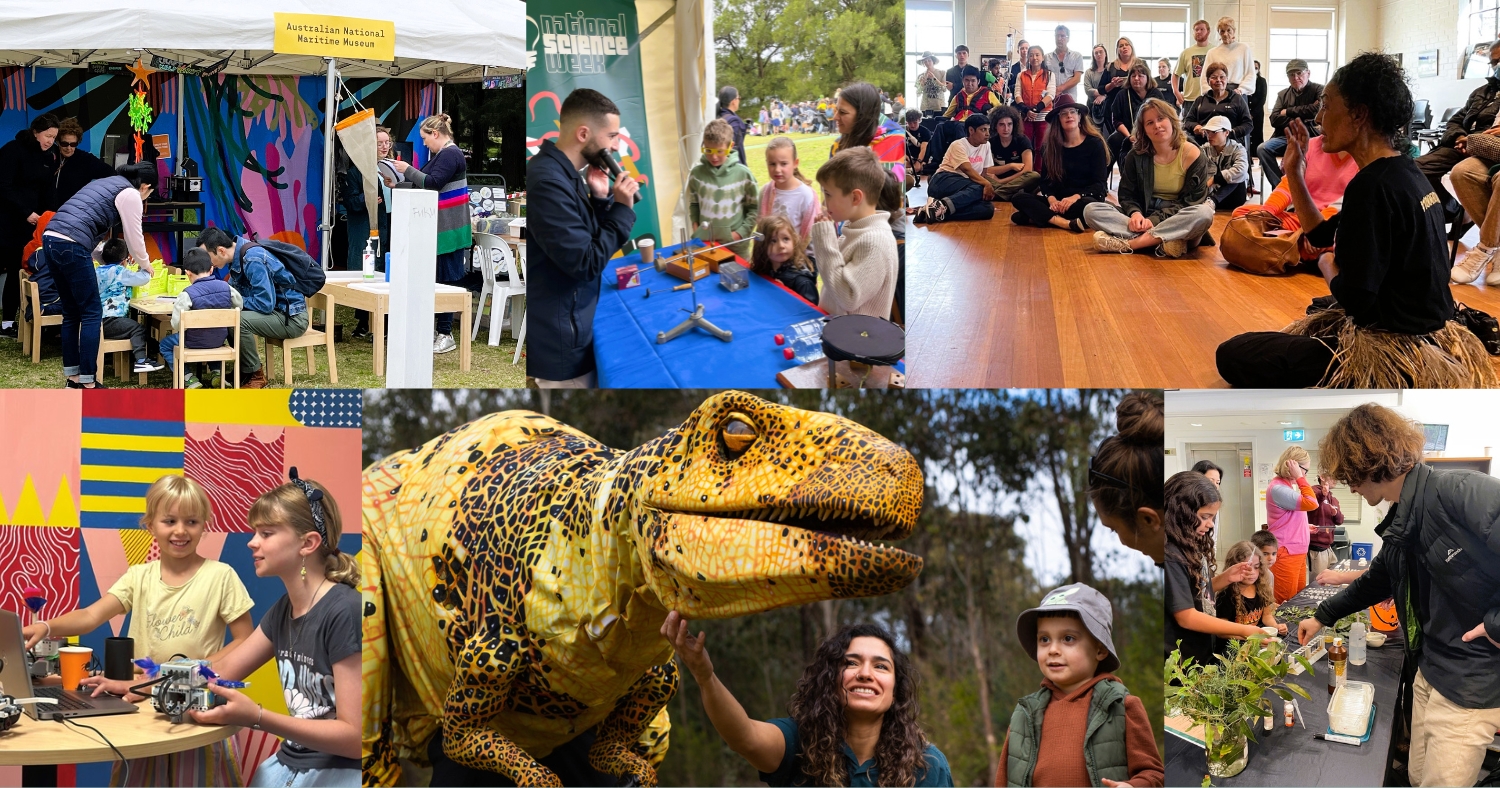
Feature Image: National Science week event composite: Science in the Swamp, Lake Mac Libraries and NISEP.


The 2025 National Science Week grants reflect the diversity of Australian science, and the myriad of ways it touches all our lives. Whether participants are looking to build skills, reflect and wonder, debate, or laugh, these events will inspire all Australians to celebrate and engage with science.
Thirty-one grants were awarded by the Australian Government for special events during 2025, with 9 coming from NSW including:
Funded event across NSW in 2025
Many of the funded events and activities will be held in remote and regional areas, with a focus on increased participation of rural communities, First Nations Australians, and culturally and linguistically diverse groups. The grants also include efforts to better engage audiences with visual/hearing impairment through sensory science experiences.
The Indigenous Science Experiences @ Redfern and the Scrub
Macquarie University, Sydney
How can virtual reality games open a portal to Torres Strait Islander culture? What does Aboriginal astronomy tell us about the night sky? And how do Indigenous knowledge systems help us understand physics, gut health, renewable energy, and more?
The Indigenous Science Experiences at Redfern Community Centre and the Scrub (Western Sydney Parklands) celebrate Indigenous knowledge systems and their impact on safeguarding natural resources, sustainable living and innovation. The program includes practical workshops and displays on the science of sound, weaving, bush foods, cultural uses of seaweeds, and movement science incorporating Aboriginal dance.
Grow Our Own: Regional STEM Industry Tours 2025
Regional Development Australia – Riverina, Griffith, Yenda,Tharbogang, Leeton, Stanbridge, Bilbul and Whitton
Grow Our Own is taking high school students behind the scenes of working labs, cellars and paddocks of New South Wales’ Riverina food bowl.
Free excursions aim to inspire young people to consider future careers in the region, covering everything from the science of winemaking to agricultural engineering, renewable energy farms and more.
Grow Our Own is an industry-led alliance of business, education, and government agencies who seek to inform and inspire young people to live, work and learn within the Riverina region.
Deaf Youth Science Camp
Australian Nuclear Science and Technology Organisation (ANSTO), Sydney
Nuclear scientists and deaf educators will visually unpack the science behind our universe – at the atomic level – in this three-day youth camp on the site of Australia’s only nuclear reactor, OPAL.
Located at ANSTO’s Lucas Heights campus in Sydney, the camp for deaf and hard-of-hearing youth (aged 12 to 17) includes workshops, site tours, 3D printing and robotics demonstrations, bushwalking and outdoor games. The camp is organised by ANSTO in partnership with Deaf Youth Australia.
The OPAL reactor produces radiopharmaceuticals for nuclear medicine and neutron beams for research. It also supplies more than half the global demand for irradiated silicon used in electronics and green technologies.
Youth Drone Project
Police Citizens Youth Clubs NSW Ltd, Moruya
Do you have what it takes to be a Drone Ranger? Find out in a two-day workshop for wannabe high-flyers aged 15 to 18. Tackle flight physics, drone structure and coding, while building and testing an aerial obstacle course.
The workshop aims to help teens develop technical and social skills like teamwork, collaboration and problem-solving, while showcasing related careers in search and rescue, environmental and agricultural research, 3D mapping, film and television, security, and more. Participants aged 16+ can also gain drone operator accreditation.
Science in the Swamp: Superpowers of Nature
Centennial Park and Moore Park Trust, Sydney
Discover the Superpowers of Nature. Explore plankton’s critical role in conservation, join bug hunts, ID a frog, learn how Indigenous knowledge systems harnesses nature’s superpowers, use solar scopes to observe the sun, or wander the wetlands.
There’s something for everyone at Science in the Swamp including wildlife encounters, science experiments, guided biodiversity walks and eco-friendly crafts. The free family event is a partnership between Centennial Parklands and a series of science exhibition providers.
Lake Mac STEAM Week 2025
Lake Macquarie City Council, Lake Macquarie
Robotics, stargazing, and a ‘Fab Lab’ for digital creatives. Lake Mac STEAM Week returns with a focus on First Nations science, art-meets-science and engineering.
Drop into Lake Mac Libraries for ‘taster’ maker workshops at the Fabrication Lab. Peer into science-themed dioramas created by local high school students. Explore the science of stargazing via a multi-sensory, 360-degree projection artwork at The Cube (located in the Multi-Arts Pavilion).
Marine Rescue: The Science behind Saving Lives at Sea
Volunteer Marine Rescue NSW. Port Macquarie
Rescue a model whale, compete in knot-tying, goggle at underwater drones and learn how waves, wind and currents impact marine rescue operations. From the chemistry of distress flares to physics of personal floatation devices, survival at sea is anchored to advances in science.
Meet marine rescue volunteers, Master mariners, an ex-Navy clearance diver, remote sensing experts, and marine and earth systems scientists at this family-friendly event focused on the scientific principles that make search and rescue operations possible.
Science on the South Coast
University of Wollongong, Nowra, Batemans Bay and Wollongong
Launch a rocket, fly a virtual reality Navy chopper, hold a crocodile, build a lava lamp, gawp at liquid nitrogen shows, examine your muscles with ultrasound, and journey through ancient Indigenous songlines. These are just some of the free activities on offer at University of Wollongong’s rural campuses (Nowra and Bateman’s Bay), and state-of-the-art Science Space in North Wollongong.
The program aims to demonstrate accessibility of science careers in rural communities, increase participation of Indigenous and culturally and linguistically diverse groups, and better engage audiences with visual/hearing impairment through sensory science interactions.
Indigenous Science Storytelling Series: Celebrating Knowledge & Innovation
Community News Hub Aboriginal Corporation. Gunnedah
How do you capture 65,000+ years of Indigenous Knowledge? Powerfully… through a series of videos, articles, podcasts and online events that showcase traditional knowledge, environmental stewardship and deadly inventions of Australia’s First Scientists.
The Indigenous Science Storytelling Series, released during National Science Week, captures the voices of Indigenous elders, scientists and environmentalists who are leading the way in conservation, technology and sustainable practices. The project will also illustrate how Indigenous and Western science can work in harmony to solve contemporary challenges, with educational toolkits for schools and community groups.
Have a look at all 31 grant projects on the link below.
Feature Image: National Science week event composite: Science in the Swamp, Lake Mac Libraries and NISEP.
Share this: