The Corridor Project has transformed invasive weeds into a living artwork in a collaborative project. Architectural Interventions, facilitated by Juan Pablo Pinto and Mavis Butters from Cave Urban, brought together 24 artists, sculptors, painters and architects over two days at the Wyangala property.
Phoebe Cowdrey, Director of the Corridor Project, said the weekend was a successful opportunity to share skills across artistic mediums and specialities -“All of the people who have been attracted to this project have an interest in the environment, in collaborative projects, learning and skill sharing amongst peers,” she said. “We’re doing something practical, for the greater good, and it’s creating something really extraordinary.”
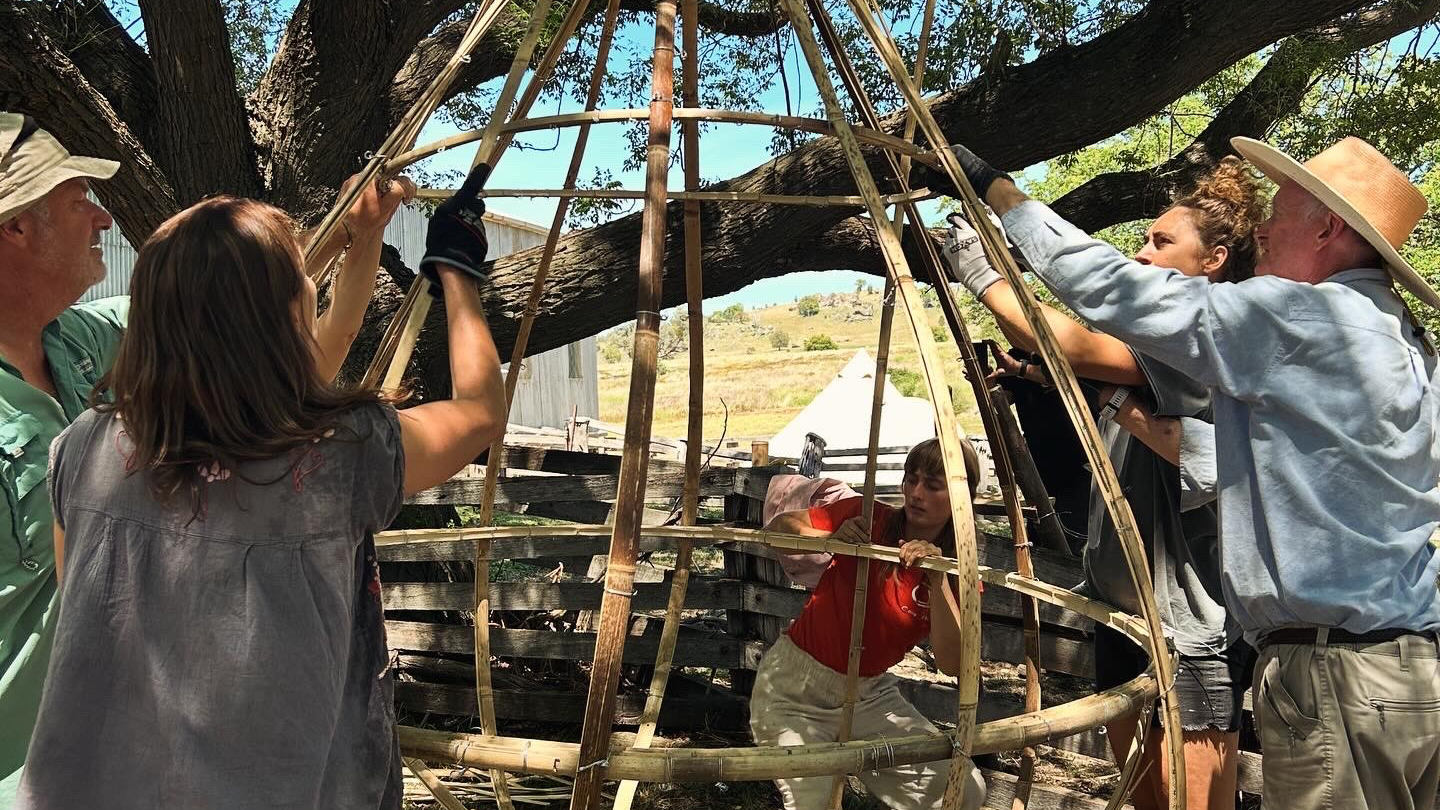
Engineering a hanging teardrop, participants gathered local reed, cumbungi and western white cedar*, to weave a structure strong enough to hold the sanctuary, hanging from an established white cedar by the property’s woolsheds.
Pinto, who recently won the people’s choice award at the Bondi Sculptures by the Sea said the opportunity to bring together artists from Cowra, Sydney, the Northern Rivers and further afield was not only a chance to collaborate, but to connect -“When you make something together, you communicate on a different level,” he said. “It’s easy to start a conversation about what you do, what kind of art you make, and to share your knowledge and skills.” – “We’re working from the land … when it comes time to dispose of the structure, it just goes back to the earth. It’s important to use invasive species, because you’re opening the ground native species to grow back in.”
Multi-disciplinary artist Ellen Ferrier travelled from Kandos to attend the workshop, a far cry from her home of Mullumbimby. Currently working with cementing and biocrete, a weekend spent weaving with weeds was an inspirational change for the artist.”It’s always good to start understanding what materials would be helpful to use,” she said. “I wouldn’t have known that the white cedar was problematic in this area, it’s such a beautiful tree. Even the St John’s Wort, they’re beautiful yellow flowers, but they’re really bad for the sheep and cattle.”- “There are so many incredible artists and minds and hands around in this space, it’s really exciting and inspiring.”
Cowra’s Ken Hutchinson also attended the event, using a pine-oil based bioweed organic spray to tackle the spread of invasive grasses. Hutchinson’s work with weeds extended beyond the Corridor project’s fence line, taking on weed control at Cowra’s Bellevue Hill as part of a Crown Reserve Improvement Fund.
The collaborative project, named ‘POD’ was completed on-site, and will form part of the Corridor project’s ERTHWRX24 exhibition, running throughout National Science Week at the Corridor Project in August 2024.
Blog post Eliza Spencer Rural and regional reporter – The Guardian | Australia for the Cowra Guardian, published originally on 21 February 2024.
The Corridor Project is supported by Inspiring NSW under the NSW Regional Science Hubs program. The Cave Urban workshop was part of their ongoing Science + Art program that brings together scientists, artists, cultural experts and community. Read more about the Architectural Interventions Cave Urban workshop, with testimonials from those who attended.
*More about the weeds
White Cedar Melia azedarach L. is an Australian native tree. It can be invasive and naturalise in disturbed and undisturbed areas, and can become a weed. More
Giant reed Arundodonax also known as elephant grass, is an introduced plant and is a weed in NSW. NSW WeedWise
Cumbungi Typha latifolia also known at bulrush or common cattail, is an introduced plant and is a water weed in NSW. NSW WeedWise


The Corridor Project has transformed invasive weeds into a living artwork in a collaborative project. Architectural Interventions, facilitated by Juan Pablo Pinto and Mavis Butters from Cave Urban, brought together 24 artists, sculptors, painters and architects over two days at the Wyangala property.
Phoebe Cowdrey, Director of the Corridor Project, said the weekend was a successful opportunity to share skills across artistic mediums and specialities -“All of the people who have been attracted to this project have an interest in the environment, in collaborative projects, learning and skill sharing amongst peers,” she said. “We’re doing something practical, for the greater good, and it’s creating something really extraordinary.”
Engineering a hanging teardrop, participants gathered local reed, cumbungi and western white cedar*, to weave a structure strong enough to hold the sanctuary, hanging from an established white cedar by the property’s woolsheds.
Pinto, who recently won the people’s choice award at the Bondi Sculptures by the Sea said the opportunity to bring together artists from Cowra, Sydney, the Northern Rivers and further afield was not only a chance to collaborate, but to connect -“When you make something together, you communicate on a different level,” he said. “It’s easy to start a conversation about what you do, what kind of art you make, and to share your knowledge and skills.” – “We’re working from the land … when it comes time to dispose of the structure, it just goes back to the earth. It’s important to use invasive species, because you’re opening the ground native species to grow back in.”
Multi-disciplinary artist Ellen Ferrier travelled from Kandos to attend the workshop, a far cry from her home of Mullumbimby. Currently working with cementing and biocrete, a weekend spent weaving with weeds was an inspirational change for the artist.”It’s always good to start understanding what materials would be helpful to use,” she said. “I wouldn’t have known that the white cedar was problematic in this area, it’s such a beautiful tree. Even the St John’s Wort, they’re beautiful yellow flowers, but they’re really bad for the sheep and cattle.”- “There are so many incredible artists and minds and hands around in this space, it’s really exciting and inspiring.”
Cowra’s Ken Hutchinson also attended the event, using a pine-oil based bioweed organic spray to tackle the spread of invasive grasses. Hutchinson’s work with weeds extended beyond the Corridor project’s fence line, taking on weed control at Cowra’s Bellevue Hill as part of a Crown Reserve Improvement Fund.
The collaborative project, named ‘POD’ was completed on-site, and will form part of the Corridor project’s ERTHWRX24 exhibition, running throughout National Science Week at the Corridor Project in August 2024.
Blog post Eliza Spencer Rural and regional reporter – The Guardian | Australia for the Cowra Guardian, published originally on 21 February 2024.
The Corridor Project is supported by Inspiring NSW under the NSW Regional Science Hubs program. The Cave Urban workshop was part of their ongoing Science + Art program that brings together scientists, artists, cultural experts and community. Read more about the Architectural Interventions Cave Urban workshop, with testimonials from those who attended.
*More about the weeds
Share this: