It was humid and muggy morning when the Evergreen tent at Woodford Folk Festival filled with people on the first official day of 203/24 Festival to find out about the Wild Yeast Zoo project.
The presentation was just one of over 100 talks and discussions over the six-day Woodford Folk Festival, a small part of an incredibly diverse program of music, art, circus, comedy, and more, for adults and children, held each year between Christmas and New Year.
Set in the grounds of an old dairy farm outside the town of rural Woodford in the lush and scenic Sunshine Coast hinterland of SE Qld, the 162-hectare site has been regenerated over 30 years by a passionate community of volunteers. The festival site, called Woodfordia, has been transformed into a beautiful precinct of regenerated dry and wet rainforest species, with mature trees providing shade and respite from the heat, and the frequent rain channelled into trickling streams and creeks.
The previous night, the iconic Opening Ceremony paid tribute to the traditional Custodians of the land, members of the Jinibara Nation, with dance and ceremony, and a magical serpent puppet lit up as it weaved through the crowd.
Talks and Ideas
The Talks and Ideas program at Woodford highlights issues of sustainability, waste and the circular economy, using Woodford’s remarkable waste system as an example of what can be done at festivals. With planning and inspiration from companies like Green Music Australia who have challenged music festivals to be places of reuse and recycling, instead of single use plastics and cheap camping gear left on site. At Woodfordia there are onsite wastewater treatment plants and an onsite water filtration plant, and a rigorous process for collecting and sorting rubbish.
The program featured 65 talk events over the six days. We also joined talks by included Costa Georgiadis on connecting communities, Grame Sait on sustainable and regenerative agriculture, plant nutrition and human health, Paul Benhaim on hemp plastics, and ornithologist Roy Sonenburg on the remarkable birdlife of Woodfordia. Rhoda Roberts AO hosted a wonderful Ancient Culture: New Conversations series with Indigenous leaders, musicians and artists, covering many topics.
Wild Yeast Zoo
At the first Wednesday session, all six members of the Wild Yeast Zoo team presented on their role in the project to collect new samples of pollen, fruit, seeds, flowers and leaves that could be used to discover new yeast species.
From the BRAT Lab at the University of Newcastle Associate Professor Karl Hassan and two of his BRaT Lab students, Evan Gibbs and Claudia Holt, joined the panel, along with ARC Future Fellow Associate Professor Amy Cain and PhD student Natasha Delgado from Macquarie University. The two non-scientist members of the team are Dr Christopher Lean, philosopher of the life sciences at Macquarie University and Dr Benjamin Matthews a lecturer in Design with the School of Humanities, Creative Industries and Social Sciences at the University of Newcastle.
The interdisciplinary team took turns to explain the important role of single-celled yeast in studying cellular processes and how one species, Saccharomyces cerevisiae (S. cerevisiae), was domesticated for wine and bread making, then was used as a ‘lab rat’ of genetics, molecular biology, and biotechnology over the last 150 of scientific research.
The team aim to find new strains of yeast in the wild that can not only can be used for brewing and baking, but can be used in biotechnology, creating new medicine such as antibiotics or anti-inflammatories, or as alternative proteins in the food production system.
To gather more samples from the field, the team developed a citizen science project, the Wild Yeast Zoo, that will enable identification of new strains by asking for collections from the community. The yeast collected will be living, so it will form a ‘zoo’, and they are taken from the wild, so it is the Wild Yeast Zoo!
It was a fascinating presentation, and the audience had many questions about the use of yeast in research, and was particularly interested to understand more about synthetic biology , and what are alternative proteins.
The team was pleased to be at Woodfordia, where that they could talk about the importance of native wild yeasts whilst ensuring they comply with an international framework to which Australia is now a signatory known as the Nagoya Protocol—specifically designed to protect the IP of landowners. Woodfordia has committed to the protocol.
The collection tours and testing
The next morning of the Festival, we joined the team on a walking tour of local plants that included an opportunity to collect new samples for yeast extraction. The tours were led by Andrew Pengelly, field botanist and lecturer, and the author of The Constituents of Medicinal Plants now in its 3rd edition. He was able to share his extensive knowledge of each plant we passed in a short walk around the site, and their many medical uses.
The Wild Yeast Zoo team accompanied us on the tour and offered the enthusiastic participants of all ages an opportunity to collect a sample of a fallen flower, fruit or seed and label it for further testing.
With three other tours the following mornings, the team were able to collect a significant number of samples that they started testing on site and storing in refrigerated units for further testing back at the University of Newcastle.
Part of their ongoing work involves making findings publicly accessible, which will be facilitated through genotyping. These findings will be shared on an interactive map towards the end of the year. The processing of these samples involved examining different species of plants, focusing on various parts of the plants and their specific locations e.g., leaves, berries, soil from base of plant.
PhD candidate at the University of Newcastle Claudia Holt was very positive about the experience. She said “Early lab results are promising, with numerous interesting microorganisms appearing. While we’re still in the initial stages of isolating yeast, we’ve already uncovered a substantial collection…Who knows, we might even stumble upon yeast strains that are entirely new to mankind, opening up a whole new world of possibilities!”
Stages of isolation. Stage 1 collecting the samples. Stage 2 enriching the samples. Stage 3 plating the enrichment. Stage 4 isolating yeast.
Reflecting on citizen science and engagement
Associate Professor Amy Cain was enthusiastic about the opportunity to speak to such a diverse and new audience. “By exploring our native plants for Australian yeast, we can discover funky home-grown yeasts that can be used for important things in our daily life, such as beer brewing. With the help of festival-goers, we hope to find some new species from the Woodford site” she said.
Dr Ben Matthews, the communication and design guru on the team agreed it was a unique opportunity to engage the community in the science. After the week, he said, “From a science communication and engagement perspective, our trip to Woodford was a stunning success! The Wild Yeast Zoo is itself a wild mix of experts from very different backgrounds and a range of universities, so bringing us together in a scrum at Woodford was the perfect way to let the power of diversity shine”.
We were able to deliver a public lecture to hundreds of people in a packed house, participate in discussion panels and Q and A’s, and lead walking tours around the beautiful country, interacting directly with groups of up to 50 people over the period of a week. This gave us a chance to chat to people about the amazing potential in the hidden world of Australian microbes, and to gather vital samples for our science project while testing out how well things like our probe kit and sample gathering process work in practice. Both our citizen science program and our science project got a big boost, bringing attention to the project and the vital science behind it. “
For Dr Chris Lean, the philosopher of science on the team, Woodford was an amazing opportunity for publicly engaged science. He said “there was an immense interest in the incredible value of Australia’s natural environment and we were fortunate to be able to give attendees the means to discover a little more about our unique microscopic world. There was a fantastic amount of interest in Australia’s unique microbial biodiversity, the attendees were incredibly engaged and interested in how discovering new yeast variants could yield new resources for brewing, baking, and many other uses”.
“Science cannot be done just in the lab. It involves the public, values, and the natural world. Woodford was the perfect opportunity to explore this intersection with publicly engaged scientific research. What stood out was the strength of support for values-based research into the utility of undiscovered biodiversity. The loudest cheers were when we stated our commitment to the Nagoya Protocol”.
Chris Lean
Synthetic biology
Amy Cain also participated in other panels and discussion on synthetic biology over the week, with scientists and other crowd favourites, Dr Karl and Costa Georgiadis.
We will share updates from the Wild Yeast Zoo team and on new strains discovered.
Inspiring Australia supported the Wild Yeast Zoo project at Woodford Folk Festival project as a collaboration between Inspiring NSW (where the scientists were based) and Inspiring QLD (where the Festival is located).
Post by Meredith Hall, Manager Inspiring NSW and Dr Anita Milroy, Manager Inspiring Queensland. Images: Katherine Williams photography Meredith Hall and Anita Milroy.


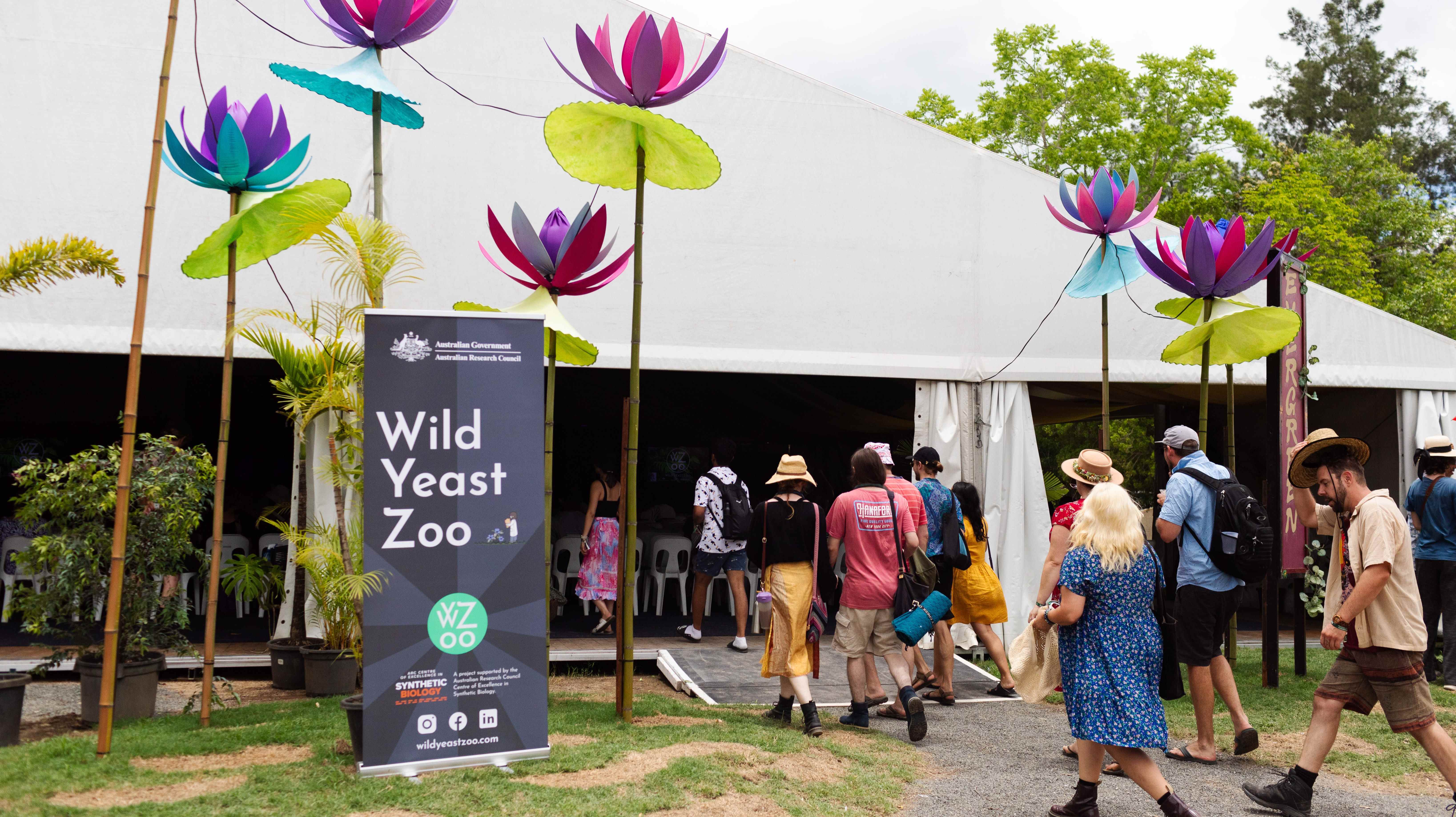
It was humid and muggy morning when the Evergreen tent at Woodford Folk Festival filled with people on the first official day of 203/24 Festival to find out about the Wild Yeast Zoo project.
The presentation was just one of over 100 talks and discussions over the six-day Woodford Folk Festival, a small part of an incredibly diverse program of music, art, circus, comedy, and more, for adults and children, held each year between Christmas and New Year.
Set in the grounds of an old dairy farm outside the town of rural Woodford in the lush and scenic Sunshine Coast hinterland of SE Qld, the 162-hectare site has been regenerated over 30 years by a passionate community of volunteers. The festival site, called Woodfordia, has been transformed into a beautiful precinct of regenerated dry and wet rainforest species, with mature trees providing shade and respite from the heat, and the frequent rain channelled into trickling streams and creeks.
The previous night, the iconic Opening Ceremony paid tribute to the traditional Custodians of the land, members of the Jinibara Nation, with dance and ceremony, and a magical serpent puppet lit up as it weaved through the crowd.
Talks and Ideas
The Talks and Ideas program at Woodford highlights issues of sustainability, waste and the circular economy, using Woodford’s remarkable waste system as an example of what can be done at festivals. With planning and inspiration from companies like Green Music Australia who have challenged music festivals to be places of reuse and recycling, instead of single use plastics and cheap camping gear left on site. At Woodfordia there are onsite wastewater treatment plants and an onsite water filtration plant, and a rigorous process for collecting and sorting rubbish.
The program featured 65 talk events over the six days. We also joined talks by included Costa Georgiadis on connecting communities, Grame Sait on sustainable and regenerative agriculture, plant nutrition and human health, Paul Benhaim on hemp plastics, and ornithologist Roy Sonenburg on the remarkable birdlife of Woodfordia. Rhoda Roberts AO hosted a wonderful Ancient Culture: New Conversations series with Indigenous leaders, musicians and artists, covering many topics.
Wild Yeast Zoo
At the first Wednesday session, all six members of the Wild Yeast Zoo team presented on their role in the project to collect new samples of pollen, fruit, seeds, flowers and leaves that could be used to discover new yeast species.
From the BRAT Lab at the University of Newcastle Associate Professor Karl Hassan and two of his BRaT Lab students, Evan Gibbs and Claudia Holt, joined the panel, along with ARC Future Fellow Associate Professor Amy Cain and PhD student Natasha Delgado from Macquarie University. The two non-scientist members of the team are Dr Christopher Lean, philosopher of the life sciences at Macquarie University and Dr Benjamin Matthews a lecturer in Design with the School of Humanities, Creative Industries and Social Sciences at the University of Newcastle.
The interdisciplinary team took turns to explain the important role of single-celled yeast in studying cellular processes and how one species, Saccharomyces cerevisiae (S. cerevisiae), was domesticated for wine and bread making, then was used as a ‘lab rat’ of genetics, molecular biology, and biotechnology over the last 150 of scientific research.
The team aim to find new strains of yeast in the wild that can not only can be used for brewing and baking, but can be used in biotechnology, creating new medicine such as antibiotics or anti-inflammatories, or as alternative proteins in the food production system.
To gather more samples from the field, the team developed a citizen science project, the Wild Yeast Zoo, that will enable identification of new strains by asking for collections from the community. The yeast collected will be living, so it will form a ‘zoo’, and they are taken from the wild, so it is the Wild Yeast Zoo!
It was a fascinating presentation, and the audience had many questions about the use of yeast in research, and was particularly interested to understand more about synthetic biology , and what are alternative proteins.
The team was pleased to be at Woodfordia, where that they could talk about the importance of native wild yeasts whilst ensuring they comply with an international framework to which Australia is now a signatory known as the Nagoya Protocol—specifically designed to protect the IP of landowners. Woodfordia has committed to the protocol.
The collection tours and testing
The next morning of the Festival, we joined the team on a walking tour of local plants that included an opportunity to collect new samples for yeast extraction. The tours were led by Andrew Pengelly, field botanist and lecturer, and the author of The Constituents of Medicinal Plants now in its 3rd edition. He was able to share his extensive knowledge of each plant we passed in a short walk around the site, and their many medical uses.
The Wild Yeast Zoo team accompanied us on the tour and offered the enthusiastic participants of all ages an opportunity to collect a sample of a fallen flower, fruit or seed and label it for further testing.
With three other tours the following mornings, the team were able to collect a significant number of samples that they started testing on site and storing in refrigerated units for further testing back at the University of Newcastle.
Part of their ongoing work involves making findings publicly accessible, which will be facilitated through genotyping. These findings will be shared on an interactive map towards the end of the year. The processing of these samples involved examining different species of plants, focusing on various parts of the plants and their specific locations e.g., leaves, berries, soil from base of plant.
PhD candidate at the University of Newcastle Claudia Holt was very positive about the experience. She said “Early lab results are promising, with numerous interesting microorganisms appearing. While we’re still in the initial stages of isolating yeast, we’ve already uncovered a substantial collection…Who knows, we might even stumble upon yeast strains that are entirely new to mankind, opening up a whole new world of possibilities!”
Stage 1 collecting the samples. Stage 2 enriching the samples. Stage 3 plating the enrichment. Stage 4 isolating yeast.
Reflecting on citizen science and engagement
Associate Professor Amy Cain was enthusiastic about the opportunity to speak to such a diverse and new audience. “By exploring our native plants for Australian yeast, we can discover funky home-grown yeasts that can be used for important things in our daily life, such as beer brewing. With the help of festival-goers, we hope to find some new species from the Woodford site” she said.
Dr Ben Matthews, the communication and design guru on the team agreed it was a unique opportunity to engage the community in the science. After the week, he said, “From a science communication and engagement perspective, our trip to Woodford was a stunning success! The Wild Yeast Zoo is itself a wild mix of experts from very different backgrounds and a range of universities, so bringing us together in a scrum at Woodford was the perfect way to let the power of diversity shine”.
We were able to deliver a public lecture to hundreds of people in a packed house, participate in discussion panels and Q and A’s, and lead walking tours around the beautiful country, interacting directly with groups of up to 50 people over the period of a week. This gave us a chance to chat to people about the amazing potential in the hidden world of Australian microbes, and to gather vital samples for our science project while testing out how well things like our probe kit and sample gathering process work in practice. Both our citizen science program and our science project got a big boost, bringing attention to the project and the vital science behind it. “
For Dr Chris Lean, the philosopher of science on the team, Woodford was an amazing opportunity for publicly engaged science. He said “there was an immense interest in the incredible value of Australia’s natural environment and we were fortunate to be able to give attendees the means to discover a little more about our unique microscopic world. There was a fantastic amount of interest in Australia’s unique microbial biodiversity, the attendees were incredibly engaged and interested in how discovering new yeast variants could yield new resources for brewing, baking, and many other uses”.
Synthetic biology
Amy Cain also participated in other panels and discussion on synthetic biology over the week, with scientists and other crowd favourites, Dr Karl and Costa Georgiadis.
Read more about these panels at the ARC Synthetic Biology website Synthetic Biology rocks Woodford Festival.
We will share updates from the Wild Yeast Zoo team and on new strains discovered.
Inspiring Australia supported the Wild Yeast Zoo project at Woodford Folk Festival project as a collaboration between Inspiring NSW (where the scientists were based) and Inspiring QLD (where the Festival is located).
Post by Meredith Hall, Manager Inspiring NSW and Dr Anita Milroy, Manager Inspiring Queensland.
Images: Katherine Williams photography Meredith Hall and Anita Milroy.
Share this: