The south coast-based Fungi Feastival premiered last year to great local acclaim. Curious as to how the organising committee got the public so excited about fungus, I decided to take a trip down the coast to see what it was all about.
The schedule ran from mid-June to mid-July 2024. It was absolutely packed with indoor and outdoor activities for adults and families including truffle hunts, kayaking and fungi tours, films, fungi photography and pottery workshops, art exhibitions, children’s classes and themed dinners. While scheduling difficulties prevented me from attending one of the many screenings of the new film Follow the Rain by Stephen Axford and Catherine Marciniak, which I was keen to see, but I did manage to attend a few wonderful events.
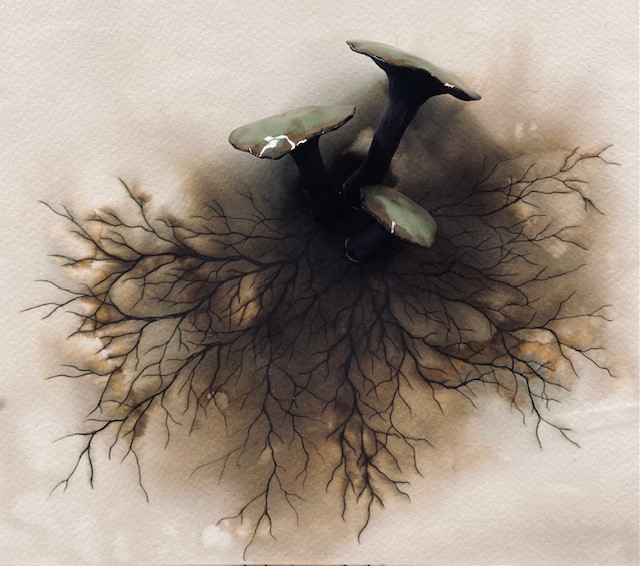
Artist Tika Robinson has a deep history with fungus, growing up on a cattle and truffle farm. Her ceramic fungi sculptures explore the links between regeneration and decay inherent in fungal structures. Exhibited at the Bateman’s Bay Library, Tika’s works were the most popular display ever shown at the library (as per Library staff!)
Fiona Kotvojs and Alan Burdon own the Gulaga Gold Trufferie, and Fiona is also the force behind the Fungi Feastival. I had the pleasure of attending a dinner celebrating the Gulaga Gold truffle at The Oaks Ranch.
Truffles are the underground fruiting body of the fungus. Fiona and Alan opened the first truffle orchard on the south coast, with first seedlings planted 11 years ago. While passing a giant truffle around the crowd for a sniff, they explained that what goes on underground is vitally important to what happens above, the truffles providing nutrients to the tree as they nestle within its roots, the whole system considered as ‘the wood wide web.’ To get the most out of a truffle, breathe at the same time to make sure you get the flavour, and always cut it thinly to get the greatest surface area. I found this most evident in the truffle ice cream, which was a burst of truffle flavour.
Offered at the Batehaven CWA Hall was an afternoon workshop on the medicinal properties of mushrooms. Mushrooms are the fungus with which we are most familiar, and most generally comfortable with stuffing in our mouths. Mushrooms are considered to lower your risk of cancer, slowing cellular damage, with some species (shiitake, king oyster, oyster, maitake) of greater value that the more common species. They are low in sodium and with their meaty texture can be added to or substituted for animal products to reduce overall salt intake. Mushrooms also assist with lowering cholesterol and improving brain health and are a rich source of Vitamin D, Selenium and B6. Additionally, mushroom polysaccharides encourage the growth of healthy bacteria in the gut.
Given that mushrooms are cheap and easy to find—and can even be grown in your own basement—it seems a no-brainer that we should all be partaking of the medicinal properties of mushrooms as much as we can.
While in the area, I also visited the Jervis Bay Maritime Museum to view Sonus Maris, a collaboration between artist Dr Nigel Helyer and engineers and scientists at the UNSW Water Research Laboratory (WRL). Helyer employs audio-visual media to reinterpret data charting the unique dynamics of intermittently closed and open lakes and lagoons (ICOLLs). We also discussed the installation of the Bidhiinja: restoring our oyster reefs at the museum for National Science Week. Further south, at the Bateman’s Bay Heritage Museum, they are also shining a light on science, through exhibitions like The Clyde Oyster: the tale of two valves, which has now been replaced by Powerful Pollinators, on display through the end of September.
The Fungi Feastival 2025 holding website is up now Home | Fungi Feastival and Fiona is already scoping content for even greater inclusion of science within the 2025 program. If located on the south coast, do consider joining in the fun, or if not, heading down the coast next winter for an enjoyable exploration of our fungal friends.
Guest post by Emily Jateff, Chair of the Inspiring NSW Executive Committee.
Feature image: Ceramic artwork by artist Tika Robinson


The south coast-based Fungi Feastival premiered last year to great local acclaim. Curious as to how the organising committee got the public so excited about fungus, I decided to take a trip down the coast to see what it was all about.
The schedule ran from mid-June to mid-July 2024. It was absolutely packed with indoor and outdoor activities for adults and families including truffle hunts, kayaking and fungi tours, films, fungi photography and pottery workshops, art exhibitions, children’s classes and themed dinners. While scheduling difficulties prevented me from attending one of the many screenings of the new film Follow the Rain by Stephen Axford and Catherine Marciniak, which I was keen to see, but I did manage to attend a few wonderful events.
Artist Tika Robinson has a deep history with fungus, growing up on a cattle and truffle farm. Her ceramic fungi sculptures explore the links between regeneration and decay inherent in fungal structures. Exhibited at the Bateman’s Bay Library, Tika’s works were the most popular display ever shown at the library (as per Library staff!)
Fiona Kotvojs and Alan Burdon own the Gulaga Gold Trufferie, and Fiona is also the force behind the Fungi Feastival. I had the pleasure of attending a dinner celebrating the Gulaga Gold truffle at The Oaks Ranch.
Truffles are the underground fruiting body of the fungus. Fiona and Alan opened the first truffle orchard on the south coast, with first seedlings planted 11 years ago. While passing a giant truffle around the crowd for a sniff, they explained that what goes on underground is vitally important to what happens above, the truffles providing nutrients to the tree as they nestle within its roots, the whole system considered as ‘the wood wide web.’ To get the most out of a truffle, breathe at the same time to make sure you get the flavour, and always cut it thinly to get the greatest surface area. I found this most evident in the truffle ice cream, which was a burst of truffle flavour.
Offered at the Batehaven CWA Hall was an afternoon workshop on the medicinal properties of mushrooms. Mushrooms are the fungus with which we are most familiar, and most generally comfortable with stuffing in our mouths. Mushrooms are considered to lower your risk of cancer, slowing cellular damage, with some species (shiitake, king oyster, oyster, maitake) of greater value that the more common species. They are low in sodium and with their meaty texture can be added to or substituted for animal products to reduce overall salt intake. Mushrooms also assist with lowering cholesterol and improving brain health and are a rich source of Vitamin D, Selenium and B6. Additionally, mushroom polysaccharides encourage the growth of healthy bacteria in the gut.
Given that mushrooms are cheap and easy to find—and can even be grown in your own basement—it seems a no-brainer that we should all be partaking of the medicinal properties of mushrooms as much as we can.
While in the area, I also visited the Jervis Bay Maritime Museum to view Sonus Maris, a collaboration between artist Dr Nigel Helyer and engineers and scientists at the UNSW Water Research Laboratory (WRL). Helyer employs audio-visual media to reinterpret data charting the unique dynamics of intermittently closed and open lakes and lagoons (ICOLLs). We also discussed the installation of the Bidhiinja: restoring our oyster reefs at the museum for National Science Week. Further south, at the Bateman’s Bay Heritage Museum, they are also shining a light on science, through exhibitions like The Clyde Oyster: the tale of two valves, which has now been replaced by Powerful Pollinators, on display through the end of September.
The Fungi Feastival 2025 holding website is up now Home | Fungi Feastival and Fiona is already scoping content for even greater inclusion of science within the 2025 program. If located on the south coast, do consider joining in the fun, or if not, heading down the coast next winter for an enjoyable exploration of our fungal friends.
Guest post by Emily Jateff, Chair of the Inspiring NSW Executive Committee.
Feature image: Ceramic artwork by artist Tika Robinson
Share this: